
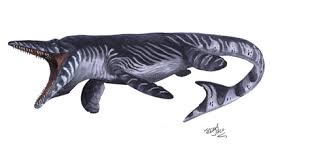
The mosasaur Tylosaurus proriger is a new finding related to the popular Tyrannosaurs rex of which everyone is familiar with. Researcher are now studying this new taxonomy and finding that this new T.rex is a massive marine reptile whose 80-million-year-old fossils were found in northern Texas decades ago.
“Everything is bigger in Texas, and that includes the mosasaurs, apparently,” said Museum Research Associate Amelia Zietlow, lead author of the new study, who is now at the History Museum at the Castle in Wisconsin.
Museum Research Associate Amelia Zietlow said, “Everything is bigger in Texas, and that includes the mosasaurs, apparently.”
Zietlow has come a long way in research first working as a comparative biology Ph.D student in the Museum’s Richard Guider Graduate School when she came across a mosasaur fossil in the Museum’s research collection in which she found was misidentified as the mosasaur Tylosaurus proriger.
There was a comparison between this specimen with T. proriger’s holotype fossil from 150 years ago in the collections at the Harvard Museum of Comparative Zoology. This has led the Museum specimen along with other dozen similar fossils held at other institutions to be classified as a different animal.
The holotype fossil for the newly described T. Rex is a giant specimen discovered in 1979 near Dallas.
Research looks at a steady problem in mosasaur evolutionary studies though the dataset traditionally used to analyze relationships among mosasaurs has been left unchanged for nearly three decades. As a result, researchers have assembled a comprehensive dataset and new arrangement of evolutionary relationships among tylosaurs.
“This discovery is not just about naming a new species,” Zietlow said. “It highlights the need to revisit long-standing assumptions about mosasaur evolution and to modernize the tools we use to study these iconic marine reptiles.”
About the Author