

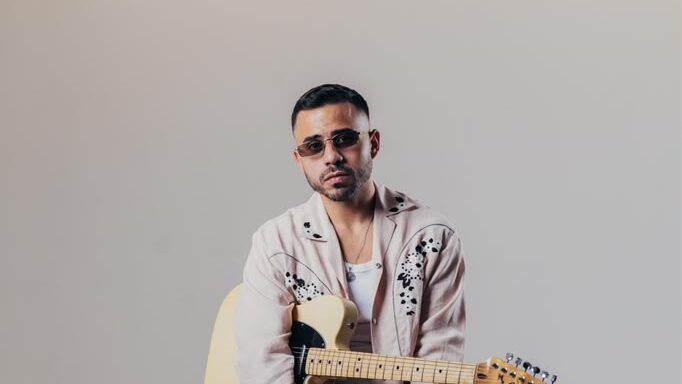
Daniel Rondon | File Image
Inside a modern recording studio, ego is often the easiest thing to stumble over. But for Venezuelan songwriter and producer Daniel Rondón, the craft demands the exact opposite: an act of deliberate surrender.
“When you create for another artist, you have to be their instrument,” Rondón explains. “You need the humility to step into their head, understand what they’re feeling, what they want to defend, and simply help them get it out. It’s about becoming a tool for their truth.”
That disciplined empathy has turned Rondón into one of Latin music’s most reliable, quiet powerhouses. Whether shaping melodies behind the mixing desk or crafting lines that linger long after the track fades, his creative footprint stretches across mainstream pop and indie-alternative spaces alike.
The industry’s biggest week—Latin GRAMMY week—finds him basking in the glow of hard-earned momentum. While the celebratory buzz of parties, panels, and red carpets fills the calendar, for Rondón, the spotlight is an affirming checkpoint rather than the final destination. This year marks his most recognized cycle yet, boasting four nominations across four distinct projects he touched.
“It’s pure pride and happiness,” Rondón says of the Academy nods. “Knowing that so many years of grind are paying off. Four nominations in one year… seeing the work bear fruit like this means everything.”
Nowhere is Rondón’s creative philosophy more evident than on “Feriado,” the critically celebrated track cut by Rawayana. While traditional pop often falls back on familiar lyrical shortcuts to describe romance, Rondón and his collaborators deliberately set out to dismantle the routine.
“With ‘Feriado,’ the goal was to praise your partner—to tell a woman how incredible she is—in a way that hadn’t quite been said before,” he reflects. “That’s the beauty of songwriting. Anyone can say ‘you’re beautiful,’ but finding a different angle to say you’re the best thing that ever existed in this universe? That subtle shift is what gave the track its soul.”
That pursuit of uniqueness mirrors a larger, undeniable cultural shift: the renaissance of Venezuelan artistry across the globe. Following years of political turmoil and diaspora that scattered a generation of creatives beyond Venezuela’s borders, those uprooted roots have matured into an international wave.
“Many of us had to emigrate and carve out spaces elsewhere,” Rondón reflects. “That was years ago, and now we’re seeing the harvest of all that resilience. It created this beautiful moment Venezuelan music is living right now.”
While his personal catalog features solo cuts like “Dos Horas” and “Mykonos,” Rondón’s current focus remains firmly locked on composition, production, and collective expansion. Alongside longtime partner and producer Rafael Rodríguez, he steers HONEYBOOS—a writing and production powerhouse that refuses to stay inside conventional lines.
The duo is gearing up to drop a marquee collaboration with Argentine trap and pop sensation KHEA. But their ambition extends far beyond chart placement. For Rondón, HONEYBOOS is blueprinting a sustainable platform designed to mentor and protect emerging creators.
“The plan has always been to build a collective that can guide new talent,” he shares. “In songwriting and production, there’s very little clear information out there on how the business works, how contracts are structured, or how to navigate the industry. We want to shorten that learning curve for talented kids coming up behind us.”
That mentorship ethos will soon see Rondón stepping fully into executive production, designing long-form albums from opening concept to final master. “It’s a step I’m taking in the very near future,” he notes. “I want to oversee complete projects, share a cohesive vision, and make things happen from start to finish.”
As studio technology evolves and generative artificial intelligence knocks loudly at the control room door, Rondón approaches the future with pragmatism rather than panic. To him, tech is a digital brush, not the painter.
“If it’s used as a utility to dig for fresh textures or sound design, that’s fine,” he says. “Where I draw the line is the melody and the lyric. The human side has irreplaceable value there. If you let an algorithm substitute human talent completely, the music is going to lack heart and soul. And how can music exist without a soul?”
Ultimately, stripped of awards, metrics, and technological debates, Rondón’s artistic anchor remains unchanged: “I always want to bet on good lyrics, on honest sentiment, and on songs that make you feel emotions. At the end of the day, that’s the work: making people feel something real with what they hear.”
About the Author