
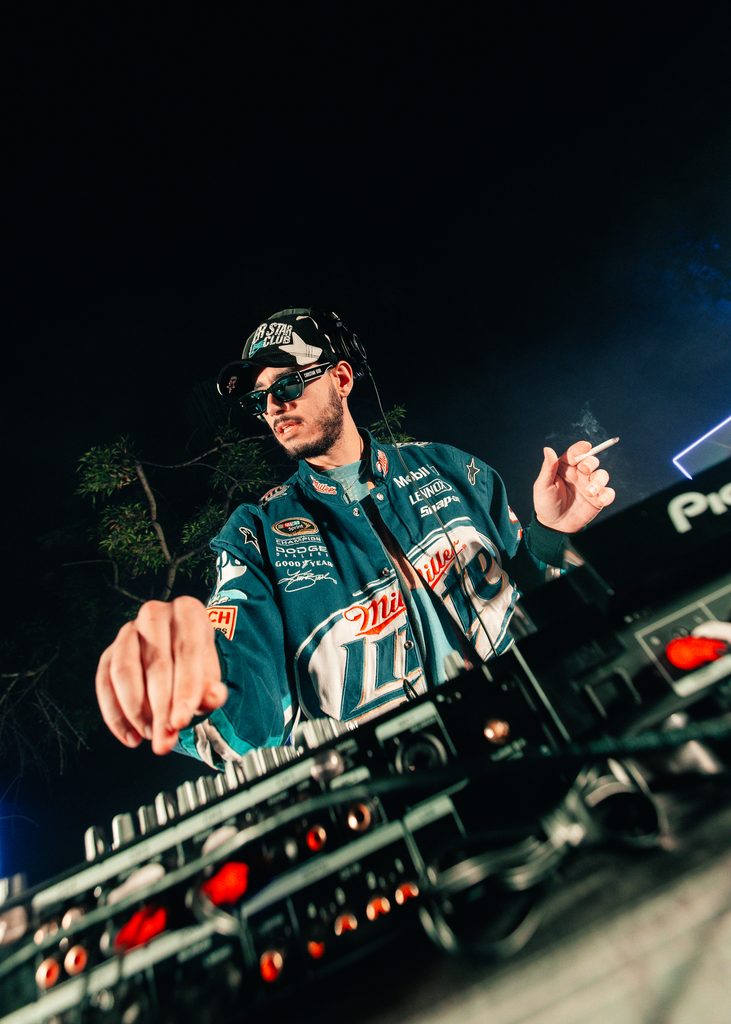
RIVS / Courtesy of RIVS
Inside Monterrey Sound, the monitoring environment was pushed to its absolute threshold the night Ramón Emilio Hernández walked through the door. The manager behind Natanael Cano dialed the playback on “PRC” until the room vibrated, stress-testing the low end before placing a FaceTime call directly to Cano to lock in the recording sessions for Nata Montana. Watching the meters was producer and engineer Rivs [Marcelo Rivera Levy], who along with his father, Abelardo Rivera, has quietly built an empire spanning more than 400 credits, 15 billion cumulative streams, two BYMA awards for Regional Mexican Producer of the Year, and three Latin Grammy wins.
Yet when the 27th Annual Latin Grammy Awards announced their nominations, Rivs wasn’t listed in the technical credits. His six-track debut EP, Contra Todo, released via Warner Music México, scored a nomination for Best Contemporary Mexican Music Album, placing him on the ballot as an artist against titans like Peso Pluma.
“It took me a lot longer than usual to wrap my head around being nominated,” Rivs says. “Last year, for instance, I was nominated alongside Tito Double P, but as a producer, the artist is the one standing out front. Now, I’m nominated with my own music, competing directly against Peso Pluma. It’s me and my project, and that represents a massive difference in my career. Just being there in the conversation alongside them is huge for me. There were so many moments in the past where I wanted to throw in the towel, but if I could say something to my younger self, I’d tell him to keep going down this exact path—because he was completely right. I’m going for that award. I’m going for the Grammy, and when I win it, it’s going straight to my house in Monterrey to be kept safe.”
That transition from console technician to marquee artist required a total reimagining of traditional Mexican acoustics, a perspective Rivs cultivated not from folkloric ensembles, but from electronic festivals and urban clubs.
“I started out as a DJ, but I realized I wanted to become an actual music creator rather than just a listener playing other people’s tracks the moment I saw an electronic music video of Skrillex and felt that energy from the jumping crowd,” Rivs explains. “In Monterrey, music is everywhere—it’s completely natural to have live bands playing at parties and celebrations without even needing a formal stage. If I’m somewhere without music, I go hunting for it. So when I build a track, I’m bringing in the energy of electronic music, 1970s rock arrangements, and hip-hop drums, and anchoring them inside Mexican music. We’re moving away from confining regional Mexican music to a single box. What we’re doing in the studio with modern fusions is proving that our music has no limits.”
That boundary-pushing production style attracted mainstream pop figures seeking authentic reinvention, including Belinda, who tapped Rivs to produce her comeback LP Indómita, yielding a Monitor Latino No. 1 hit on “La Cuadrada” with Tito Double P.
“When Belinda came to my studio, it wasn’t some strange shock that we were doing regional music, because she has listened to Mexican music her entire life,” Rivs reveals. “Working together was completely natural. She wanted a fusion that balanced her pop identity with the global wave of corridos, so for ‘Cactus’, we took on the challenge of blending synthesizers, subtle chimes, and a full string quartet arrangement over the acoustic foundation. Her voice adapts to any style, and what we unlocked in the studio showed that this new musical revolution in Mexico isn’t a novelty. It’s an evolution.”
Despite commercial success engineering hits for Junior H, Oscar Maydon, and Fuerza Regida, the creative friction of commercial work-for-hire eventually triggered the birth of Contra Todo.
“In regular studio sessions with other artists, ideas or experimental fusions would constantly emerge that the artists didn’t dare include on their own albums because it pulled them too far out of their comfort zones,” Rivs admits. “Contra Todo became my excuse to give those ideas a home, taking artists out of their usual habits and assuming 100% of the creative responsibility. I called it Contra Todo because during the process, it felt like pushing against everything. We had a massive music video shoot completely ruined by bad weather, and people who were close to the project lost faith and got discouraged. But taking full ownership of your art means standing behind it when no one else will.”
The crown jewel of the EP arrived when Rivs flew to Florida to work alongside Colombian rock legend Juanes, crafting “Beso de Novela”.
“Juanes invited me to his studio in Miami just to vibe and create with no set agenda,” Rivs recalls. “I had brought five pre-written songs with me to see if he liked any of them, but after talking for a bit, we decided to throw them away and start entirely from zero. Juanes started imagining a narrative about a couple, a dramatic kiss, and the concept of a classic novela. The song came together in about 15 minutes. But mixing it was the biggest creative challenge on the EP. Juanes comes from rock and pop, and we were making an authentic Mexican corrido. The difficulty was embedding true regional identity while completely respecting his essence and phrasing. I built four distinct versions before finding the one that felt right, and then we went straight to the jungle in Costa Rica, right near an active volcano, to shoot the video.”
The rest of the tracklist reflects that same deliberate collision of genres, uniting Venezuelan rapper Akapellah with Santa Fe Klan on “Me Iluminé”, and bringing Dan Sanchez and Nueva H together on “El Rollie”.
“I ran into Santa Fe Klan in the studio, and he mentioned he was looking to cut a track with Akapellah,” Rivs says. “I built a beat that bridged Venezuelan hip-hop and trap with regional Mexican acoustic guitars, and the collaboration came together naturally. With ‘El Rollie’, I brought in writers who helped launch the original Corridos Tumbados Vol. 1 movement, fusing their street composition style into my production universe. Every song on Contra Todo lives in the same world because of that curation.”
For Rivs, introducing international figures like Juanes or Argentine trap artist Cazzu into the genre is the only way Mexican music will secure permanent global dominance.
“I love that we’ve made regional Mexican music expand far beyond just Mexicans singing it,” Rivs argues. “When international artists of that stature—whether it’s Juanes, Cazzu, or Karol G—step into our world, they validate that our music deserves that global spotlight. The roots are the same ones that have existed for generations, but this modern wave isn’t a temporary trend. It arrived to stay.”
Managing an empire that spans producing Sahir Montoya’s album A 220, tracking for Thalía, and prepping upcoming collaborations with Oscar Maydon requires an uncompromising work ethic.
“Being in the studio for 18 hours straight isn’t about chasing fame or chasing money—it’s pure obsession and love for the art,” Rivs concludes. “I manage it by staying extremely organized day by day: sleeping well, staying healthy, and working out. Moving forward, my goal is to venture into the Anglo market, collaborate with American hip-hop artists, work with acts like Ca7riel & Paco Amoroso, and keep expanding this sound on a worldwide scale. That’s what’s next for me: making the biggest things I’ve ever done in my life.”
About the Author