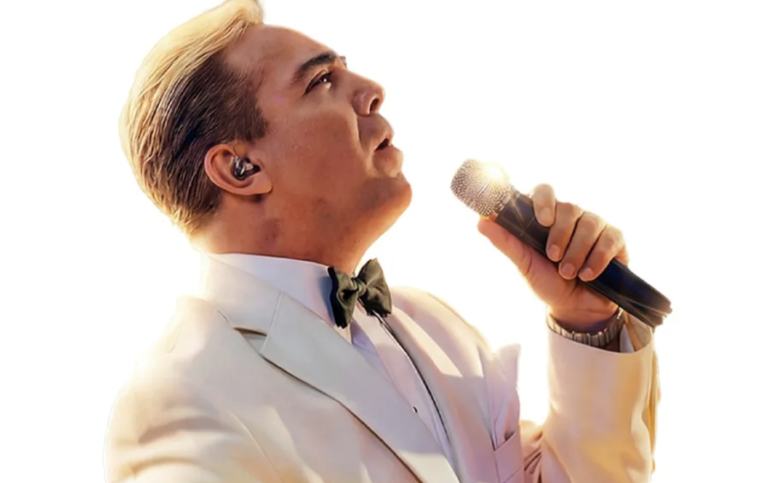

Bad Bunny at Super Bowl LX, Feb. 8, 2026, in Santa Clara, Calif. Photo Credit: Edwin Rodriguez
A few years ago, mainstream pop music in the U.S. was still largely shaped by English-language releases and clearly defined genre boundaries. Even when artists outside the English-speaking world were gaining global audiences, their music was often labeled as “international” or separated into its own category rather than being fully absorbed into mainstream pop. That separation has become much less consistent in recent years, especially as streaming platforms and social media have changed how music moves across audiences.
One of the clearest examples of this shift is Bad Bunny. He has built a global audience while releasing music primarily in Spanish, without adjusting his work to fit English-language expectations in the way earlier international artists often did. His songs regularly appear on global streaming charts, and his reach extends across regions where Spanish is not the dominant language. His visibility has also expanded into mainstream U.S. pop culture conversations, including ongoing discussion around major entertainment spaces such as the Super Bowl. Taken together, his career reflects how Spanish-language music is increasingly part of mainstream pop culture rather than positioned outside of it.
A recent example within that broader shift is Titi Me Preguntó by Bad Bunny. The track is performed entirely in Spanish, but it circulated widely through streaming platforms and social media after its release. It appeared across major playlists and spread through short-form video content, moving through algorithm-based discovery rather than traditional radio promotion. Its reach reflects how songs can now gain global visibility without being adapted for English-speaking audiences.
Platforms like Spotify and TikTok have played a major role in this change. Songs are often discovered through curated playlists, algorithmic feeds, and user-generated clips rather than through radio or label-driven promotion. Because of this, a single sound or moment from a song can circulate widely across different countries without listeners needing to understand every lyric. Language is no longer a fixed barrier in how music spreads, but one part of how a song is experienced online.
Some of the clearest examples of international music breaking into mainstream U.S. listening come from songs that spread globally through streaming and social media rather than traditional industry promotion.
Example:
- Dynamite by BTS
Became a global hit after its release and reached major commercial success in the U.S., including a number one debut on the Billboard Hot 100. The song gained widespread visibility through streaming platforms and social media sharing, marking a major moment for K-pop in mainstream American pop culture. - Despacito by Luis Fonsi and Daddy Yankee
Became one of the most streamed songs globally and spent multiple weeks at number one in the United States. Despite being primarily in Spanish, it remained central to mainstream U.S. listening during its peak, driven heavily by streaming, radio crossover, and remix circulation. - Mi Gente by J Balvin and Willy William
Gained global traction through streaming platforms and social media, later receiving a high-profile remix featuring Beyoncé. The song became widely recognized across both Latin and U.S. pop markets and strengthened the visibility of reggaeton in mainstream pop spaces.
What connects these examples is not a single sound or language, but the way music now moves through digital platforms. Streaming services and social media have made it more common for songs to reach global audiences immediately, without separate regional versions or traditional promotional rollouts. As a result, music that blends languages and cultural influences is no longer positioned outside the mainstream, but increasingly part of it.
This shift is also visible in listening habits. Audiences are now regularly exposed to music from different countries and languages through algorithm-driven platforms, curated playlists, and viral content cycles. Songs often gain traction based on sound, emotion, or a specific moment that circulates online rather than linguistic familiarity. Over time, that exposure has changed what listeners recognize as standard within pop music.
As these patterns continue, mainstream pop music is becoming less defined by geography or language and more shaped by global circulation. Instead of moving toward a single unified sound, pop music is increasingly reflecting multiple influences at once, with artists building careers that exist across languages, genres, and cultural spaces simultaneously.
About the Author