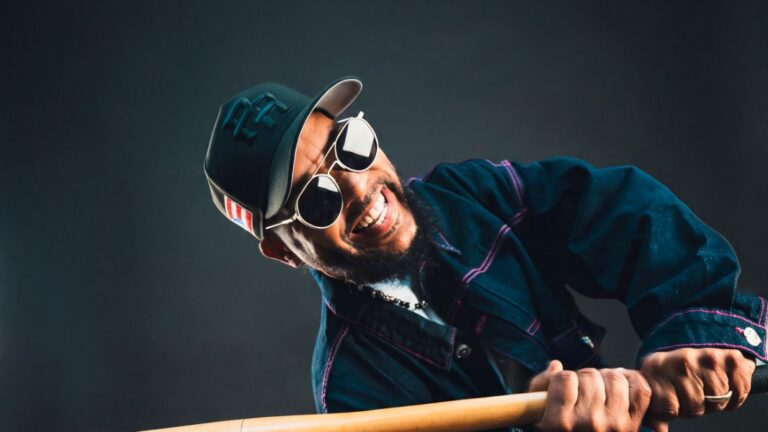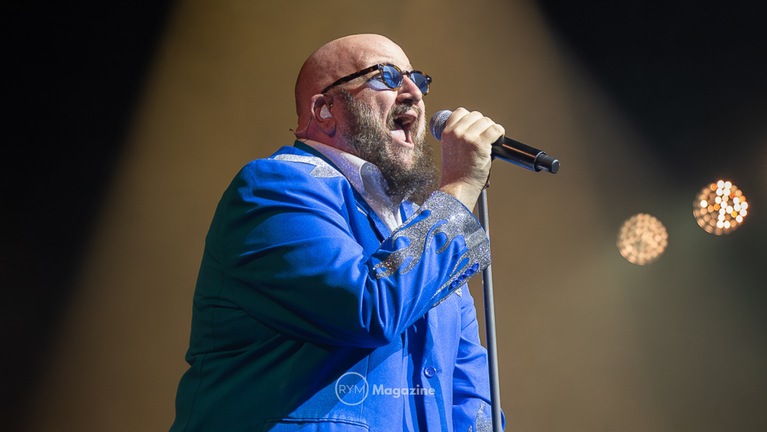
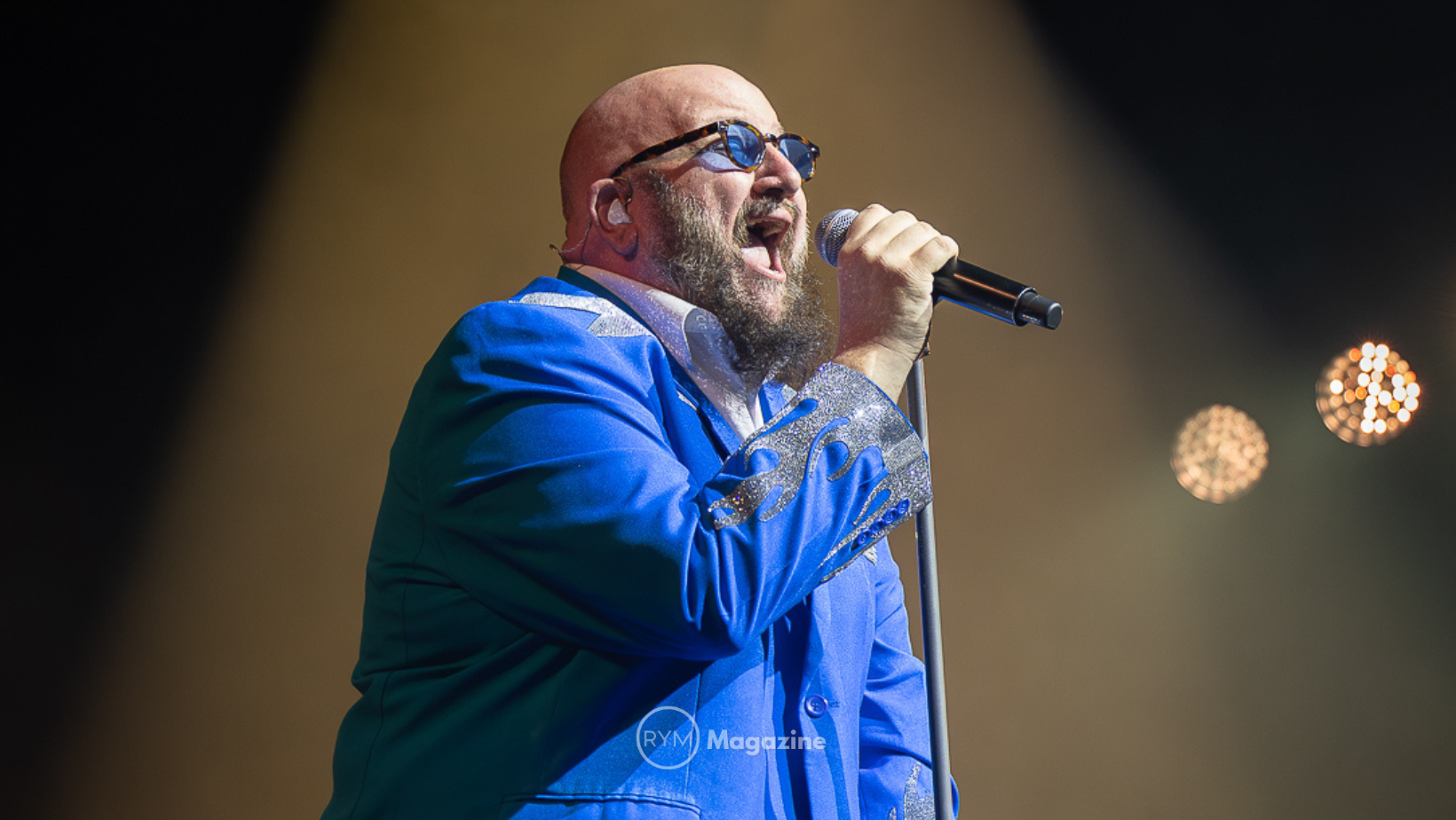
Stephen Kramer Glickman | Photography By Stephen Zenith
Cover Story Exclusive | By Vanessa Torres – Editor-In-Chief
From animated tyrant Gustavo Rocque to raw, 490-track orchestral covers, the actor and singer breaks down the grief, gear, and stadium ambition powering his studio debut, Rhinestone Monster.
Stephen Kramer Glickman understands the visual dissonance he creates. For four seasons on Nickelodeon’s Big Time Rush, he occupied the cultural subconscious of an entire generation as Gustavo Rocque: a bellowing, manic, hit-obsessed caricature of an old-guard music executive. Today, with billions of global streams, sold-out arena runs, and an arsenal of custom, hand-rhinestoned stage armor from downtown Los Angeles, Glickman is demanding to be heard not as a Hollywood footnote or a novelty act, but as a vocal powerhouse executing high-wire pop deconstructions.
Ahead of his full-length studio album Rhinestone Monster (releasing December 4 via Red Slushy Records) and hot on the heels of his newly premiered funk-metal reimagining of Peter Gabriel’s “Sledgehammer,” which dropped last Friday alongside a cinematic, star-studded visual, Glickman sat down to unpack the fine line between camp and catharsis, processing intergenerational trauma on stage in Poland, and what happens when an artist stops chasing the algorithm to build something colossal.
When Olivia Rodrigo released “Drivers License” in 2021, the world filed it as bedroom-pop melodrama—an intimate teenage diary set to minimalist keys. For Glickman, it was raw, mid-’90s alternative rock waiting to be excavated.
“I think it’s one of the best breakup songs ever written,” Glickman says. “I had gone through a breakup where I felt like I had to reclaim the entire city for myself. Suddenly, I related to Olivia Rodrigo, which felt crazy to me at first. But her songwriting is built like ’90s rock. ‘Good 4 U’ is structurally closer to a Nine Inch Nails song than teen pop—it’s so close to ‘Something I Can Never Have.’ We actually went to our guitarist numerous times to build an industrial Nine Inch Nails version of ‘Good 4 U’ before we pursued ‘Drivers License.’”
Rebuilding the track alongside ’90s radio balladeer Edwin McCain, Glickman swapped bedroom intimacy for driving guitars, cavernous live drums, and a vocal trade-off that turned Rodrigo’s suburban heartbreak into an adult reckoning.
“That bridge—the red lights, the stop signs—as a singer, that piece of the song was just so fun to perform,” he explains. “When you start a song like that or Chappell Roan’s ‘Pink Pony Club,’ you start and the audience kind of chuckles or giggles at first. They’re like, ‘Oh my God, what are they doing?’ But then you come in with the big guitars and the drums, and you actively watch an arena get completely won over by your version. It always reminds me of what it’s like to have to move on and reclaim your town. Sometimes a relationship can ruin an entire town for you; it really is your job to reclaim it.”
That geography of heartbreak extends far beyond romantic splits into the physical map of everyday survival. “There are places to this day from other relationships in my life where I simply can’t go to that restaurant anymore,” Glickman admits, leaning into the comic absurdity of his own coping mechanisms. “I haven’t spoken to my father in 12 years. Recently, I went to the last restaurant we ate at together before I cut him out of my life. I was just hungry and completely forgot that was the spot where we spoke for the last time. I sat down, ordered food, and then the memory hit me. I lost my appetite instantly. When it happened, I thought, ‘This is a great way to lose weight! Forget Ozempic—have you tried Trauma Restaurants?’ I could make a commercial for it. But that’s the reality of emotional baggage: places hold ghosts until you decide to take them back.”
If “Drivers License” leaned into emotional salvage, Glickman’s take on Peter Gabriel’s 1986 art-rock touchstone “Sledgehammer” is pure, unapologetic adrenaline. Conceived alongside touring guitarist Soren Chrisell, the track marries vintage 1970s funk with the bombast of arena metal.
“Doing this cover, I give the credit to Soren Chrisell, my guitarist that I toured with all over the world,” Glickman recalls. “I’m a huge fan of the original and the stop-motion video that took hundreds of hours to film. Soren came to me and said, ‘I think we can funkify this song.’ We tried it at the piano right behind me, went over it once, and I said, ‘Let’s do it funky, but let’s also do it as if it was going to be the opening theme song to Peacemaker—a little ’80s hair metal, a little ’70s funk.’ On the Big Time Rush arena tour, a lot of folks that grew up watching the show didn’t know Peter Gabriel. To them, it felt like an original. The first night, maybe 20 or 30 people were singing ‘Kick the habit!’ back to us. By show 34, we had tens of thousands of people screaming it in the arenas.”
The visual matches Gabriel’s original iconoclasm with surrealist camp, featuring an unpredictable ensemble that spans generations: cult cinema icon Deep Roy, Disney alumnus Lucas Grabeel, street-dance pioneer Flattop, Emmy winner Ruba, and digital creators including Queen Julia, Lilsyourfav, and Sean Barrett.
“The pitch across the board was people working regular jobs who get swept up in the groove of the song and start to get super flirty and wild out,” Glickman explains. “In the 1980s, if there was a scene with a model being sexy in a mechanic shop, it would have been a blonde woman in a Guns N’ Roses video. We wanted to feature people bringing their own sexuality to a song that is literally about having sex. Having Ruba in there doing the sexy mechanic scenes was so fun. From the jump, I wanted Flattop breakdancing on a countertop in a hardware store while an elderly woman gets completely turned on. With Lucas Grabeel, the pitch was: women are washing his car, and then he looks up and there’s a guy in a leotard standing on top of the car grinding it out, and Lucas is sitting there thinking, ‘What the f is this guy doing?’*”
Then came Deep Roy. “I went to Deep Roy and said, ‘I want you to climb up the side of a mountain at 78 years old in 112-degree summer heat dressed like a Jedi, a Jawa, or a magical Hobbit.’ Once we were up there, I handed him a flute and said, ‘Can you grind on the flute? Can you make it kind of sexual?’ It felt like an insane thing to ask an absolute legend, but he went for it completely.”
Yet when approaching sacred catalog anthems, Glickman adheres to a strict editorial rule: you either reinvent the track completely, or you revere every note precisely as it was written. There is zero middle ground. When the band tackled The Killers’ “Mr. Brightside” on tour, they refused to touch its architecture.
“We did ‘Mr. Brightside’ by The Killers on tour note for note, exactly the way that it was originally written and performed,” Glickman stresses. “If you slow it down, it ruins it. If you change the time signature, it ruins it. If you change the key, it ruins it. It needs to be done the way it was originally written. People ask if I’d ever produce a music video for a cover like that, and the answer is no. You cannot touch or compete with what the original video already accomplished. The original music video is so good, so iconic. Unless you can bring a totally distinct visual world to the table—like going full 1930s black-and-white cinema like The Smashing Pumpkins did for ‘Tonight, Tonight’ inspired by A Trip to the Moon, or building giant handmade sets with marionette puppets—you don’t dare copy it. If you can’t steer away and do something that honors the original by offering an entirely new piece of art, it’s just a waste of time.”
That reverence reached its creative zenith on Rhinestone Monster with an astonishing 490-track orchestral deconstruction of My Chemical Romance’s 2006 rock-opera masterpiece “Welcome to the Black Parade,” recorded as a vocal duel with original Rent Broadway lead Adam Pascal. The arrangement’s operatic gravity was forged through personal history and profound grief during a tour stop in Poland.
“We were scheduled to perform in Krakow, and everyone warned us that visiting the concentration camp beforehand was going to be emotionally devastating,” Glickman reflects. “What I didn’t count on was what happened inside. In one room, they have the shoes; another has glasses. Then you walk into the room with the suitcases. Sitting right on top of a pile of luggage was a suitcase with my last name written across the front.”
“It hits you in waves. I come from a big Jewish family. Relatives of mine, great-grandparents, would have ended up there. The fact that my Jewish community and I are alive and thriving today gives you this sense of survival and pride, but it is an emotionally terrifying place. It was only 70 or 80 years ago. Walking out of there knowing I had to take the stage the next night, I was an absolute wreck. I was full of so much emotional turmoil that I couldn’t walk out and sing Britney Spears’ ‘Toxic’—which is on the record and so much fun—because it couldn’t hold the weight of what I was feeling. I needed a vessel that could carry all of that grief and survival. We had worked on ‘Welcome to the Black Parade’ and planned to debut it to close Wembley Stadium in London, but we put it in the set that night in Krakow. The entire crowd knew where we had been the day before. Standing at the microphone singing those words by Gerard Way—‘Though you’re dead and gone, believe me, your memory will carry on’—completely altered the DNA of the song for me forever.”
Capturing that magnitude in the studio required a colossal production effort led by Grammy-nominated producer Jason La Rocca.
“I told the label that if we were doing this, it had to feel like a Queen record,” Glickman says. “We needed an orchestra, flutes, and a full choir to build the sound. On this album, a track like Sienna Spiro’s ‘Die on This Hill’ has 26 tracks in the session. ‘Welcome to the Black Parade’ has 490 tracks. It has 15 layers of my vocals, live drums, live guitars, and Adam Pascal. I’ve been a massive fan of Rent since seeing him play Roger on Broadway. When we were building the album, I put myself out there hard. I asked so many people to be on this record, and a lot of people said no. You get rejected constantly. But I channeled that boldness, reached out to Adam, and when he said yes immediately, I cried. Jason La Rocca meticulously went line by line mapping our trade-offs, and I went back in to cut all the harmonies. Even though I didn’t write it, I feel connected to that song in the deepest part of my soul.”
“Standing at the microphone singing those words by Gerard Way—‘Though you’re dead and gone, believe me, your memory will carry on’—completely altered the DNA of the song for me forever.”
Stephen kramer glickman
Reconciling that depth with his comedic roots required a total collapse of creative boundaries—a freedom granted directly by his former castmates during Big Time Rush’s 73-city, sold-out Live Nation arena world tour.
“When Big Time Rush asked me to go on the world tour with them, I asked, ‘What songs am I allowed to do to open for you? What are you okay with?’” Glickman shares. “They looked at me and said, ‘Do whatever you want.’ I told them, ‘Don’t say that to me, because I will open this show with Rage Against the Machine.’ And they went, ‘Do it. It’s your time.’ So we opened half the arena shows with ‘Killing in the Name’—my band would hit that groove, I’d march out onto the stage, and we’d tear into it. Other nights, they brought me out to AC/DC’s ‘Back in Black.’ It was so unbelievably freeing to be entirely myself without having to adapt or censor myself for a children’s network or cater to expectations.”
That stage freedom birthed the physical and sonic identity of Rhinestone Monster, allowing Glickman to inhabit two sides of the same coin: the unvarnished vulnerable musician and the theatrical showman.
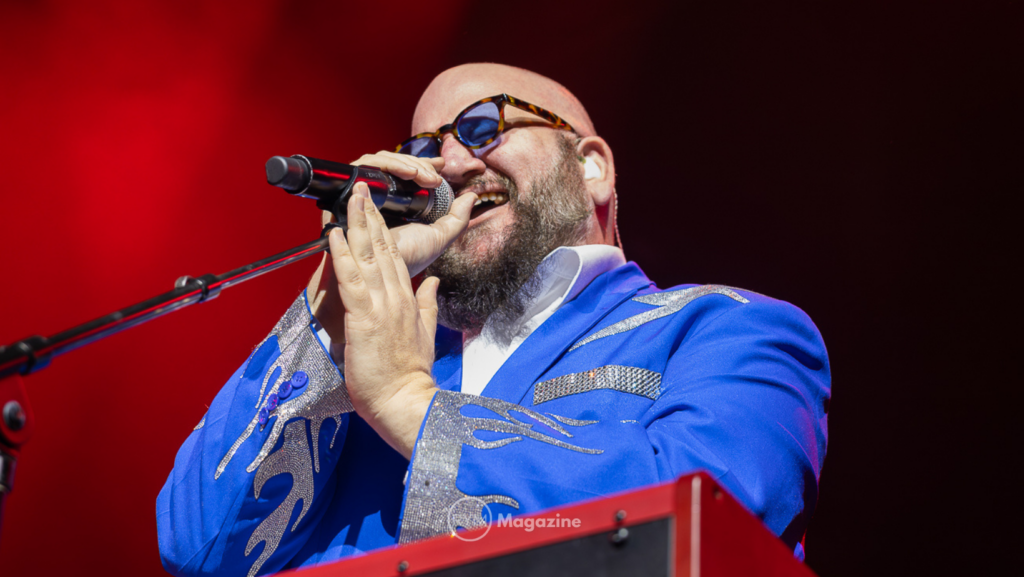
“To stand on stage every single night in front of 25,000 or 30,000 people, I felt like I had to become the ultimate, alter version of myself,” he explains. “It was like entering the Super Saiyan God level, like Goku in Dragon Ball Z: Battle of Gods and Dragon Ball Super—you have to ascend to this entirely new, powerful state of being just to command that space. To get there physically, I didn’t just buy stage clothes. I went down to Planet Rhinestone in downtown Los Angeles. The owner and I took raw pieces of clothing—leather jackets, suits, three custom pairs of shoes—and hand-glued every single stone, imbuing each piece with that energy. Wearing that heavy, shining armor made me feel invincible on stage. It turned me into a rhinestone monster.”
Yet beneath the glitter and stadium volume sits striking vulnerability. During the tracking of the Goo Goo Dolls’ “Iris,” Glickman stripped away the walls of sound entirely.
“We were planning to record ‘Iris’ like the original, with big alt-rock guitars,” he reveals. “During a break at the studio, I went over to the baby grand piano, put a photograph of my girlfriend on the sheet stand, slowed the tempo down to a crawl, and sang the entire song directly to her. I didn’t even know they were rolling tape. When the last note faded, my drummer Buddy Gibbons and Soren looked at me from the control room and said, ‘That’s the take. It has to go on the album.’ All we did was bring in cellist Marza Wilks to play underneath it. I recorded that song for the woman I love, and that raw, unedited take is the one listeners will hear.”
For an artist whose early career was defined by playing Gustavo Rocque—the furious maestro hunting manufactured radio hits at all costs—navigating the real music industry has brought Glickman full circle.
“Gustavo was singularly obsessed with numbers, charts, and manufactured perfection,” Glickman says. “When my cover of Gnarls Barkley’s ‘Crazy’ hit billions of streams, none of it was calculated. That taught me that you can’t make music just hunting for a hit; you make it because you love it, and if it connects, wonderful. What I took from Gustavo was his boldness. He was a very ballsy character, very brave in his choices, and he believed in himself. Putting this album together, I had to put myself out there hard and take the hits when people said no. But I went in saying, ‘You know what? I am going to ask Edwin McCain to sing with me. I am going to ask Adam Pascal.’ You have to be brave enough to ask, surround yourself with elite people like Kelly and the boys on the show, and trust their ears.”
He grins. “The sharpest contrast between me and Gustavo in the studio? When I run a session, I order Jamba Juice for everyone. I make sure my band and crew are fed, respected, and happy. Gustavo never had love in his life, which is probably why he had so many anger issues. Maybe he would have had fewer anger problems if he had been in love on the show. That’s my vote: if they ever reboot the show or do a special where we’re fighting against AI music, we’ve got to get Gustavo a lady! When you make records surrounded by love, trust, and your friends, you don’t need to throw chairs to make something unforgettable.”
As Glickman prepares to release Rhinestone Monster to the world on December 4, he isn’t running from his comedic past, his internet virality, or the cartoonish music mogul that first put him on the map—he is simply claiming every inch of the stage on his own terms. And if fans ever get their wish for a Big Time Rush revival down the road, our only hope is that Glickman is given the room to infuse Gustavo Rocque with the very same heart, vulnerability, and genuine love that drives this record. Between the deafening live drums, the intricate four-hundred-track orchestrations, and the thousands of hand-placed crystals catching the light, Stephen Kramer Glickman has finally found a sound big enough to hold the full measure of his life: equal parts armor, grief, laughter, and stadium-sized soul. “I just hope people listen to these songs, tell me what moves them, and let me know where they want us to go next,” he says with an easy grin, looking past the studio glass and toward the road ahead. “Meeting the people who grew up with me, looking them in the eye, and sharing that room together—that’s the real show. That’s what makes all of it worth it.”
About the Author