
By Teresa Coben & Stephanie Ou | Senior Editor | Staff Writer
There is a distinct, almost sacred reverence required to step onto the stage at Carnegie Hall. It is a world governed by absolute discipline, immaculate sheet music, and the weight of centuries-old traditions. Back in 2017, a young virtuoso walked onto that legendary stage, debuting as a classical piano soloist. To the classical world, she was a rising star of the conservatory, a product of rigorous national and international piano circuits.
But music has a funny way of breaking out of the boxes we build for it.
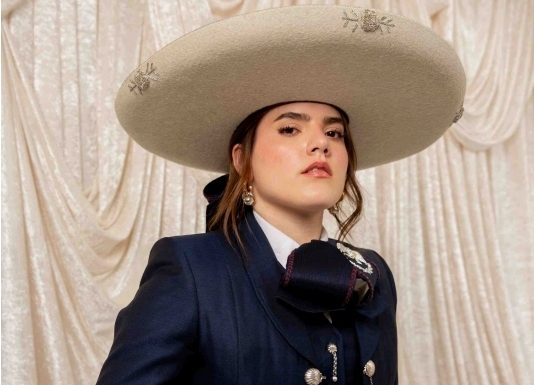
While she spent her days mastering the precise mechanics of classical piano and percussion at school, her evenings inside her childhood home belonged to an entirely different kind of magic: the raw, syncopated heartbeat of cumbia played on her accordion. For years, that side of her musical identity was a private sanctuary.
Today, performing under the moniker La Coreañera, she has successfully shattered the wall between the high-discipline classical scene and the improvisational, high-energy universe of cumbia sonidera. Fusing her two musical selves has become a lifelong mission, proving that cumbia is not just rhythms— it has customs, rules, and a deep heritage.
Transitioning from a world of strict sheet music to a genre deeply rooted in an aural tradition and street culture is a spiritual reorganization. In the cumbia sonidera scene, things are felt and learned by ear rather than read on a page. Many musicians don’t read music at all; you play a melody for them once, and they instantly capture the vibe. Instead of viewing this as a barrier, La Coreañera understood that she could apply the same study tactics and strict discipline she had learned in. school directly to her accordion and cumbia practice.
“I had a very strong formation in classical music since I was very young,” she reflects. “But when I was in my home, I would play cumbia on my accordion. I played the accordion since the same age as my piano-playing skills, but I never took it to a stage because there wasn’t the same opportunity.”
The turning point arrived when she moved to Mexico to work as a classical percussionist. The transition completely changed the way she saw her music, shifting her perspective from strict classical training to the energetic discipline of cumbia.
In Mexico, she observed her conservatory peers living double lives as hueseros—working musicians who played strict classical scores by day and commanded the stages of versátiles bands, salsa clubs, and bailes by weekend.
“I noticed they’re in the conservatory playing classical music, and on the weekends, they’re out playing with different bands—playing cumbia, salsa, banda,” La Coreañera says. “That kind of inspired me. I said, ‘Okay, so I don’t have to keep only playing cumbia in my house. I can take it out of here and do both things.'”
To understand the true depth of this bridge between two worlds, one needs to look no further than La Coreañera’s recent, show-stopping appearance with the legendary group Yaguarú Sinfónico for their 30th anniversary concert. Having previously graced massive stages like Mexico’s Auditorio Nacional as a guest artist, stepping into Yaguarú’s symphonic iteration expanded her views on the genre.
Yet, injecting classical musicianship into cumbia requires an artistic calibration that cannot be taught in a classroom. “Sometimes it’s hard to make a classical musician play with the same swing, with the same flavor,” she notes. “Cumbia doesn’t have rigid rules, but it has customs that most people in the genre should know as musicians.”
It was a magical night because of the way she brought her orchestral roots and her cumbia world together on a massive scale.
For the artist, born Abigail Pak, the night was a rare opportunity to strip away the immense pressure of fronting her own project and sink back into the collective, anonymous power of an orchestra.
“When you’re on stage by yourself, in front of a crowd, and you’re the main voice and the main accordion, it’s a lot of pressure,” La Coreañera admits with striking honesty. “There’s a difference when you’re part of a team—an orchestra where maybe you’re only 5% of the group, but every single 5% is so important. You’re still responsible, but you can relax because you are supported by everybody around you.” Dressed in a formal gown—a stark contrast to the streetwear-inspired outfits her cumbia fans are used to—she managed to seamlessly blend her orchestral roots with street-level energy. The audience response proved that her fans didn’t just love the persona; they loved the musician behind it.
“At the end of the show, I could hear people screaming, ‘Coreañera, te amo!’ I hadn’t dressed like La Coreañera; I dressed like Abigail when I went to my classical concerts. No one who follows my project had ever seen me in a dress! It was so amazing how people saw both sides and recognized the classical music preparation behind it.”
This brilliant collision of high-art precision and raw street instinct dictates the exact DNA of her production style. Her song “Ximenita” was inspired by her sister and came straight from her heart, with the lyrics written down during a single sit-down. “I was in my room, and I hadn’t seen my sister in a while, so I was feeling kind of sad,” she recalls. “The lyrics—I wrote them in one go. I didn’t even revise them afterward. It came straight out of my heart.”
La Coreañera builds her tracks from the ground up, composing the intricate instrumentals before ever putting pen to paper for lyrics. It is a meticulous, completely self-contained process. On her latest release, “Koreacumbia,” that labor of love has finally manifested into the definitive thesis statement of her career, featuring music that seamlessly combines both her Korean heritage and her love for cumbia.

“When I was in the studio with my musicians, we mutually said to each other, ‘This is the sound I’ve been looking for since a long time ago,'” she says proudly. “I played the piano in the recordings, I played the teclados, the accordion, everything. This song in particular… it just makes me happy, and I feel very satisfied. I put ‘Koreacumbia’ as the name because I feel like this song is very me.”
Staying true to her brand, La Coreañera operates as the ultimate matriarch of her project, personally organizing the communications, hiring, and coordination of everything for her band. She has carefully curated a diverse mix of members, ranging from those who studied in the conservatory to those who have played street joints all their lives. During the grueling music video shoot for “Koreacumbia,” she personally managed the logistics, styling, and communication for over 25 individuals to ensure her team felt respected and valued.
“The day was very tiring, but everyone had a really good attitude because they told me, ‘Abi, this is our song. As your musicians, we love it.’ Genuinely seeing everybody so happy to be dancing and playing—even some of my musicians who didn’t dance before started dancing! The direct human connections I build is to ensure our cumbia makes people dance naturally.”
As a Korean-American woman with Korean parents growing up in the cultural melting pot of San Antonio, Texas, La Coreañera’s journey has never been about choosing one identity over another. She has formed a deeply personal identity by combining her classical training with her other passions like the accordion and the cumbia. “I took time off from college because I realized cumbia is where I belong,” she says, a choice she wouldn’t trade for anything else. She has built a bigger stage where all of her worlds can dance together—and with “Koreacumbia” leading the charge, the radical metamorphosis is complete.
About the Author