
As projection designer and visual architect Olivia Sebesky continues to redefine the live stage—bridging classical fine-art composition with high-velocity real-time rendering—the language of live performance is undergoing a historic transformation. From arena rock residencies to massive global music festivals, this is how the digital canvas came alive.

Photo Courtesy: Olivia Sebesky
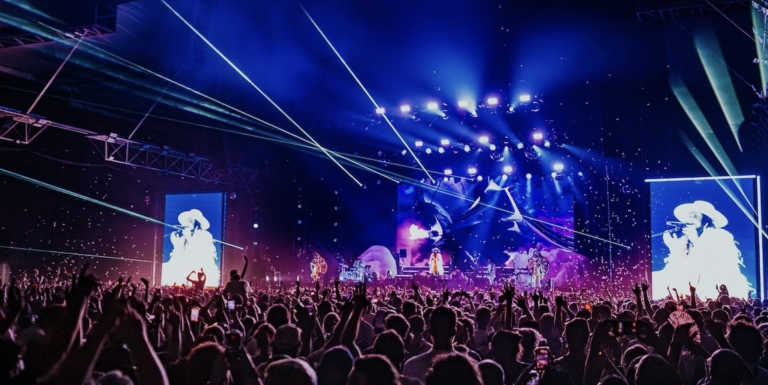
Before the first distorted power chord tears through the arena air, an audience has already made its judgment. Long before the amplifiers warm to a hum, modern concertgoers are immersed in light, shadow, and architectural scale. The static backdrop—that beloved, dust-covered canvas banner of rock tours past—is dead. In its place stands an interconnected, pulsing nervous system of 8K LED volumes, robotic projection heads, and real-time generative media engines that reshape the stage with every downbeat.
At the center of this technological revolution is Olivia Sebesky, a fine-art painter turned visual architect and projection designer who operates in the high-stakes engine rooms of live entertainment. Her visual fingerprints are stamped across some of the most technically ambitious spectacles in modern music and theater: orchestrating Aerosmith’s sprawling Las Vegas residency preshow, transforming country star Lainey Wilson’s arena run into a Parnelli Award-nominated triumph, building a photorealistic 3D rain-soaked Waffle House for Hootie & The Blowfish, and carving out the stark, evocative stage environments that earned her a 2024 Drama Desk nomination for Broadway’s Melissa Etheridge: My Window. For modern live spectacles, where the visual threshold for rock performance is being pushed into uncharted territory, her journey provides both a field manual and a philosophy, proving that no matter how many terabytes of data you fling across a stage, visual spectacle means nothing without human narrative.
Her career arc mirrors the live event industry’s evolution over the last two decades. Trained in painting and illustration at Northeastern University’s College of Arts, Media and Design, her early professional days were defined by drafting physical theatrical scale models and mixing physical pigments. But as digital projection technology began seeping into scenic design, she saw an expansive new frontier. “Although I work behind a screen all day long, it doesn’t change how much it’s driven by art,” she says of her methodology. “Designing for big screens is essentially a way that I can paint on a massive scale without the hesitation of material cost or preparation.”
That painterly heritage remains her primary weapon. While lesser productions drown artists in sensory noise, foundational fine-art disciplines—compositional hierarchy, negative space, color harmony, and brush-gesture physics—are applied directly to massive LED arrays. Whether crafting visuals for Carrie Underwood at Stagecoach, James Taylor, or Shakira in Times Square, digital light is treated as a physical scenic medium rather than an electronic billboard.
Designing visuals for rock royalty is a delicate tightrope walk between honoring legacy and matching raw sonic power. For Aerosmith’s Las Vegas residency, teaming up with lead director Amy Tinkham, scenic designer Josh Zangen, and lighting designers Nick Whitehouse and Cosmo Wilson solved a complex narrative challenge: how to prime thousands of fans before Steven Tyler and Joe Perry even step onto the deck. The result was a monumental 35-minute preshow retrospective. Rather than relying on simple montage loops, the creative team undertook the massive archival effort of scouring, restoring, and legally clearing decades of historical footage to build a cohesive narrative arc. The preshow operated as an emotional crescendo, building tension across the arena until the live screens exploded into real-time visuals alongside the band’s opening riff.
That same spatial storytelling applies to classic rock staples on the road. During Hootie & The Blowfish’s arena tour, her team conceived a 3D set that brought their signature roots to life. For the ballad “Let Her Cry,” the stage transformed into an uncanny, photorealistic 3D Waffle House exterior. Observers noted that “it makes you feel like Hootie is playing in a Waffle House parking lot,” while virtual raindrops cascaded down the video screens with such depth and dimensional refraction that the effect was “so credible you half expected Rucker to towel off afterwards.”
Behind these photorealistic environments lies an industry-wide departure from pre-rendered video clips. For decades, live concert video was linear: motion graphics were pre-rendered, exported into ProRes or Hap video codecs, and locked rigidly to audio timecode tracks. If an artist lengthened a guitar solo by eight bars, the video track ran out of runway. Today, real-time generative graphics engines—primarily Unreal Engine and Notch—have transformed the concert visual control booth into a dynamic rendering pipeline. Visual environments can now respond instantaneously to lighting consoles via Art-Net or sACN, react to audio stems, or track performer motion on stage in real time.
To manage these colossal visual streams, production teams rely on Disguise media server platforms, an ecosystem she has operated since 2009 when working alongside company founder Ash Nehru during Green Day’s American Idiot tour. “Disguise’s reliability is unmatched,” she notes, pointing to how the platform separates the staging puzzle into the Timeline Level for cueing, the Stage Level for a 3D digital twin of the arena, and the Feed Level for pixel-mapping to physical hardware.
Yet, running real-time graphics at scale introduces its own technical headaches. “The biggest challenge for somebody like me is dealing with the relationship between software and hardware,” she explains. “If your machine is souped up, it will only be as good as the software catching up to the hardware and vice versa.” While many peers build towering, liquid-cooled custom PC rigs, she relies heavily on Apple Mac Studios for mobile workstations, leveraging unified-memory architecture and thermal efficiency to turn around rendering jobs under intense on-site deadlines.
The journey from a digital twin in previsualization to the thunder of the main stage is hammered out during tech—the notoriously punishing production rehearsal phase. For a major production, life at the tech table follows a relentless 15-hour rhythm. “By 9 a.m., I am sitting at my tech table at the theater while crew call is happening—lights being re-focused, scenic paint and build, projectors being refocused,” she recalls. “My team and I will be editing content in preparation for rehearsals. Usually around noon, rehearsals begins with all departments and cues are built, changed, edited, cut, and rebuilt.” Work continues straight through the dinner break, followed by evening rehearsal blocks that run until 11 p.m. and all-hands production debriefs that routinely push past midnight.
The physical realities of the gig dictate radically different approaches depending on whether a show is touring or parked in a resident venue. Designing Melissa Etheridge: My Window on Broadway allowed the team to calibrate high-lumen projectors with millimeter precision. “We designed the system around where we can hang the projector in the space, and we never had to think about a different space for it,” she explains. “That’s the biggest difference when you’re trying to create the technology package for any given show. You have one space that you stay in for months as opposed to tearing it down and going to the next city night after night.”
On a global festival or touring rock rig, that luxury vanishes. At the MDLBEAST Soundstorm festival in Riyadh, Saudi Arabia—an electronic and rock mega-event featuring five stages with massive LED parks—she designed screen graphics across sprawling, custom art-piece stages. In that environment, raster maps had to be engineered to withstand varying outdoor throws, extreme weather, and rapid festival changeovers.
As live events hurtle deeper into the decade, the conceptual wall separating real architecture from digital illusion is collapsing entirely. The industry calls it phygital space—the complete convergence of physical staging and virtual media. For Jordan Brand’s 30th anniversary at the Adler Planetarium, real-time planetary data was mapped onto the venue’s overhead dome while Michael Jordan archival footage played across bespoke miniature displays. In corporate headquarters, dynamic 360-degree ambient LED environments have been authored to shift fluidly from serene meditation spaces to energetic social hubs. Looking ahead, non-traditional reflective surfaces are taking center stage, from upcoming attraction work with Universal Studios to projecting directly onto dynamic water screens. “Incorporating projections on water introduces a whole new texture and dimension to our designs,” she notes.
In an industry sector that has historically leaned heavily male, her rising stature is breaking barriers. Her technical leadership was highlighted in the documentary Like a Woman, which profiled women reshaping male-dominated professions. When navigating high-pressure live environments, she frequently references a piece of advice passed down from her early mentor, Tony-winning designer Justin Townsend: “Always be the most helpful person in the room.” To the next generation of visual artists, her counsel remains grounded: “Be ready, open, and patient with your learning process. The field is constantly evolving, and there’s always something new to learn.”
For the future of live performance, the lesson is unmistakable: the rock spectacle does not belong to the biggest, brightest LED wall or the flashiest pre-baked loop. It belongs to designers who can command cutting-edge real-time engines, tame complex media servers at 2 a.m., and use digital light to make an arena of twenty thousand people feel intimately connected to the soul of the performance on stage.
About the Author