PAVLO GONCHAR/SOPA IMAGES/LIGHTROCKET VIA GETTY IMAGES
As Billboard strips video data from its charting algorithms, the industry faces a radical new reality: you can be the most-watched artist in the world and still be a ghost on the charts.
The glow of three oversized monitors illuminates a cramped bedroom in an Atlanta suburb, the only light in a room where the sun set hours ago. On the center screen, a Youtube dashboard shows a number that would have been a career-defining milestone just a year ago: 15,402,191 views. The twenty-year-old producer sitting in his chair, proud of his contribution to the competitive Youtube music world. Every refresh of the browser brings another ten thousand views. The comments are full of fire emojis and international timestamps, a digital roar that suggests he is currently the center of the musical universe. In the logic of 2024, this young producer is a superstar waiting.

But on Tuesday morning, an important day for the music industry, he opened the Billboard Hot 100 tab and began to scroll. He checked the top 10, the top 50, and finally reached the bottom of the list. Within those 100 artists, his name isn’t one of them. Despite having a large fanbase and being a big hit on Youtube, he is, by the official metrics of the American music business, invisible. The disconnect is the result of a quiet but violent divorce between the world’s most influential video platform and the industry’s most prestigious chart – a move that effectively removes the value of Youtube views from the charts and leaves the viral vanguard stranded in a landscape they no longer recognize.
Online attention doesn’t equal success for industries anymore. For a decade, music videos were the gateway to the Hot 100. A kid with an Iphone and a dream could make it at the top of the list, out-charting a legacy pop-star. Now, starting January 2026, those days of “mass-streaming” glory have been shuttered. In an era where labels are desperate to concert ephemeral “likes” into cold, hard subscription revenue, Billboard has drawn a line. If a fan isn’t paying for the privilege to listen, the industry has decided that the listen simply doesn’t count.
In 2013, Youtube streams began being incorporated into the Hot 100 list. Billboard used to count Youtube because they wanted to be relevant to young people. If there was a song that turned into a viral meme, that would typically be high on the Hot 100 list. Like the “Harlem Shake” moment. This EDM track went #1 purely because people were filming themselves dancing in costumes. This was the moment the industry realized they could no longer control what a “hit” was. As time went on labels were getting frustrated that their marketing on Youtube did not earn them anything, and Spotify was where they couldn’t market, yet that’s where they earned. Not only were labels frustrated, but legacy artists were as well. They felt the charts were being hijacked by memes. Adding even more conflict Youtube was creating. According to Billboard, Youtube voluntarily is withholding data for all global charts because as Lyor Cohen explained on Youtube’s official blog, the weighting formula “doesn’t reflect how fans engage with music today and ignores the massive engagement from fans who don’t have a subscription”.
At the heart of the “Billboard-Youtube Divorce” is a stark economic reality known in boardrooms as the Value Gap. Popularity no longer automatically translates to profit. A song’s popularity might feel like a universal discovery, but the checks being cut to record labels tell a different story. In this current marketplace, a stream is not just a stream. It is a financial transaction with a tiered class system.
According to industry reporting, Spotify’s average payout per stream generally falls between about $0.003 and $0.005, depending on listener type and geographic factors, with premium subscribers typically generating more revenue than free listeners. By contrast, Youtube Music’s per-stream payouts are widely estimated at around $0.002, reflecting its ad-supported model and lower average revenue per listener. These numbers illustrate why major labels viewed free video streams as devalued compared with paid subscribers
This is why Universal Music Group, Sony, and other major labels pressured Billboard to decouple Youtube from the Hot 100: they wanted the charts to reflect profit, not just popularity. Paid streams now carry weight because they represent money flowing into the industry, whereas viral Youtube views, even in the hundreds of millions, don’t guarantee a cent.
Billboard did attempt a compromise in 2025 by narrowing the gap. They moved the weighing ratio from 1:3 (one paid stream = three free views) to 1:2.5 (one paid stream = 2.5 free streams.). But, Youtube found this insulting. Through its Global Head of Music, Lyor Cohen, the platform argued that the revised formula undervalued non-paying fans and insisted on 1:1 parity, maintaining that a fan is a fan regardless of subscription status.
When no agreement was reached, Youtube, Lyor Cohen himself, announced on Youtube’s official blog that it would stop delivering streaming data to Billboard beginning January 16, 2026, meaning Youtube views will no longer be factored into the Hot 100 or other Billboard charts. Billboard has updated its streaming methodology to weigh paid subscription and ad-supported audio streams differently, and without Youtube’s data, video streams will effectively no longer influence chart rankings.
There are many genres and fandoms who will struggle with this major shift Youtube is creating.
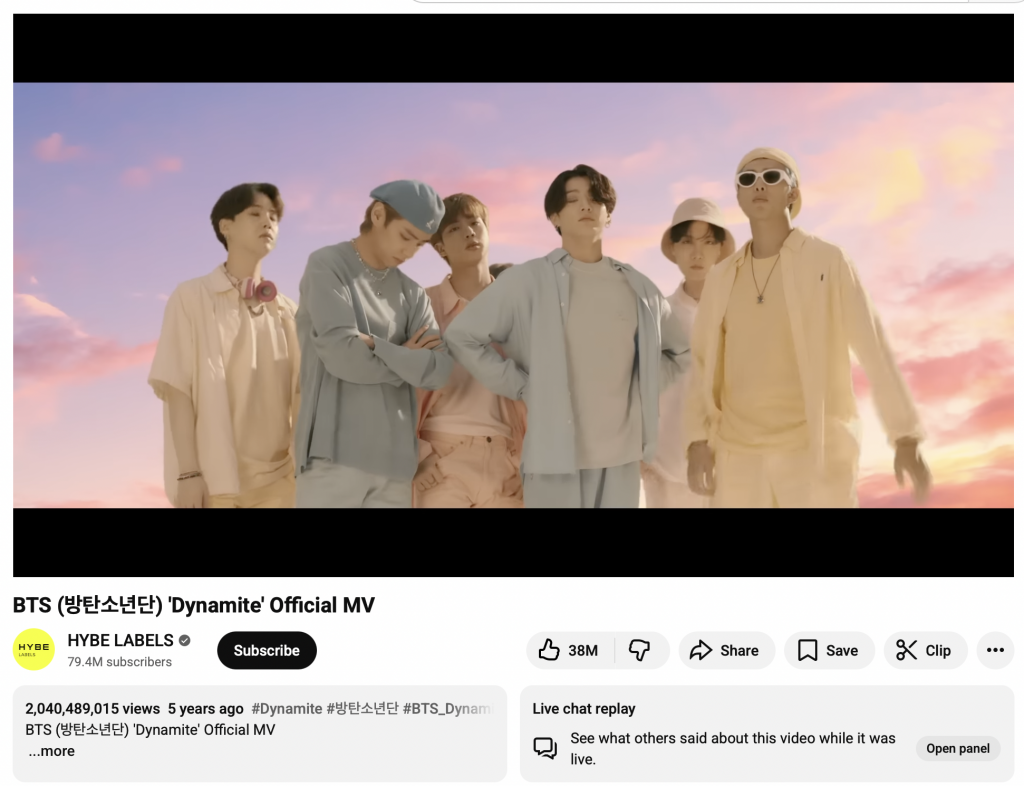
In 2021, BTS broke the record for most views in 24 hours on a video for their song Dynamite with 101 million views. The BTS fandom, the “Armies”, created this goal for themselves, and they reached it. How did they achieve this? Not only did they put the video on a constant loop to up their views, they also had streaming parties where fans across the globe use VPNs and browser loops to inflate numbers. But now, that power is gone. Putting their music video on loop won’t do anything for them anymore. This move that Youtube decided on is a direct anti-cheat measure against these fandoms.
The “Street Pipeline” in hip-hop refers to the informal, grassroots network through which music and cultural trends emerge from urban communities and spread to a wider, mainstream audience. It is the authentic, unfiltered source of new sounds, styles, dances, and slang that major labels and media outlets eventually adopt and monetize. In Hip-Hop, the music video is the culture. Now, with this new shift, it will make it harder for new Hip-Hop artists to blow up. If a video doesn’t count toward a chart, how will they be known across media? Sure, people can watch the music video then go listen to the artist on Spotify. But, if most people are discovering this artist on Youtube, they might like the artist for their visual presentation and the way they are telling the story through visuals rather than just words.
On Spotify, the top spots are dominated by artists like Taylor Swift and Bad Bunny, along with other Pop and Hip-Hop acts with massive radio and subscription backing. In contrast, Country and Classic Rock, which attract older, suburban fanbases more likely to pay for subscriptions, will benefit under the new system, while K-Pop and other globally viral artists will struggle. With these popular artists and genres, the Hot 100 will now likely become stagnant. Without the chaos of Youtube viral hits, the top of the charts will be dominated by the same 5-10 superstars who have massive radio and subscription backing. Meanwhile on Youtube, Latin superstars take many of the top spots, along with K-Pop groups like BLACKPINK and BTS.
Knowing this information, it is evident how K-Pop groups especially will be taking a hard hit with Youtube backing out of the charts. This rule change seems to be saying fandom doesn’t count as consumption. By removing Youtube, they are effectively silencing the most passionate, organized fanbases in the world. It shifts the power from the global fan back to the American suburban listener who just listens to what’s on the radio.
The big question is, does the music video still matter? If a label doesn’t get “points” for a video, will they still spend $500,000 on a cinematic masterpiece?
In 2026, there will likely be a big shift with the music video industry. There will most likely be less big videos, and more cheap “vertical loops” meant for TikTok, a platform that is now known to discover new artists.
This young producer in Atlanta just had the ladder pulled up from him. All the views and followers he gained don’t mean much besides being a Youtube star. This won’t help him grow as an artist because he is stuck in Youtube, where the views don’t mean much anymore.
The Sidebars
The Math:
2016: Approximately 1,500 video streams equaled one album sale.
2025: Billboard attempted a compromise, adjusting its methodology so ad-supported audio streams counted at a 1:2.5 ratio compared with paid subscription streams.
2026: After Youtube announced it would stop delivering streaming data, Youtube video streams will no longer factor into Billboard’s chart calculations, making Youtube-only hits effectively invisible on the Hot 100.
The Invisible Hits:
“Gangnam Style” was a huge hit on Youtube. It was the first video to hit 1 billion views. It peaked at #2 on the Billboard Hot 100, with video streams playing a significant role in its chart performance.

“Harlem Shake” hit #1 simply because it went viral and there was a trend involved.

“This is America” by Childish Gambino was a massive cultural event, specifically the music video. It debuted at #1, with video streams accounting for most of its first week total.

Without those video “points”, would these songs have debuted at #1 and #2?
Youtube Data Withdrawal:
According to Billboard, Youtube has decided to stop delivering streaming data for all global charts. As Lyor Cohen explained, the platforms rejected Billboard’s proposed compromise because it “ignores the massive engagement from fans who don’t have a subscription,” maintaining that a fan is a fan regardless of whether they pay. Which now means Youtube streams will no longer factor into Hot 100 rankings.
About the Author