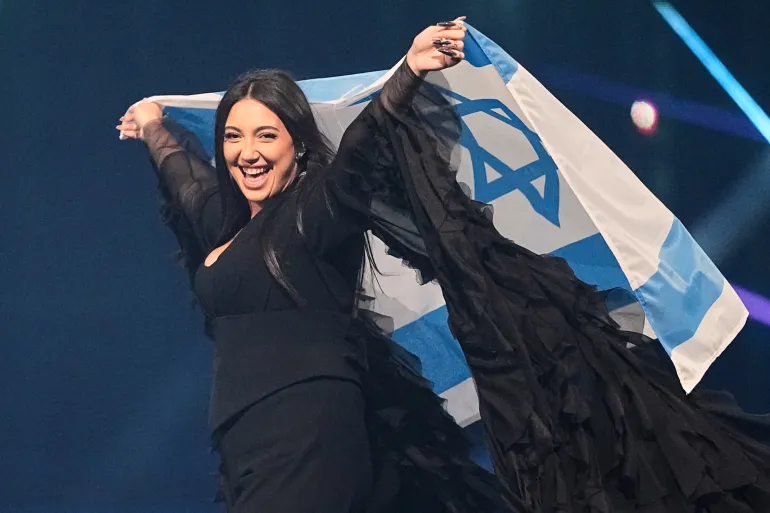
Israeli singer Yuval Raphael holds Israel flag during dress rehersal performance for Eurovision Song Contest on May 16th, 2025. [File: Martin Meissner/AP Photo]
Four countries in the European Union have decided to withdraw from next year’s Eurovision due to the controversy surrounding Israel’s participation in the competition. These countries include Ireland, Spain, Slovenia, and the Netherlands. The boycott follows weeks of pressure on the European Broadcasting Union (EBU) to hold an internal vote on whether Israel should remain eligible for Eurovision amid the ongoing conflict in Gaza. After the EBU declined to schedule that vote, the four countries said they could no longer take part in the competition.
The decision has reignited debate around politics in Eurovision, a contest that asserts itself as a non-political celebration of music but regularly finds itself pulled into international disputes. With millions of viewers worldwide, Eurovision often becomes a stage where cultural diplomacy and political tension visibly intersect.
This begs the question of whether or not to let politics infiltrate the music business. There is much discourse and debate concerning the competition amid the world’s political atmosphere. To some, stepping back from Eurovision is a principled stand — a clear statement about where their values lie. To others, it feels unnecessary, a political gesture unlikely to influence real-world outcomes. But avoiding political entanglement becomes nearly impossible when Eurovision is broadcast on a global scale and carries cultural weight far beyond music.
In statements explaining their withdrawal, broadcasters cited concerns over the humanitarian crisis in Gaza. Ireland’s RTÉ called participation “unconscionable,” while Spain’s RTVE said the EBU’s refusal to hold a vote undermined its confidence in the contest’s decision-making. Slovenia and the Netherlands issued similar concerns about transparency and accountability.
The EBU has confirmed that Israel will continue to participate in Eurovision 2026, and organizers have not announced any structural changes to the show. It remains unclear whether more countries will join the boycott or how these withdrawals could impact one of the world’s most-watched music events.
About the Author